
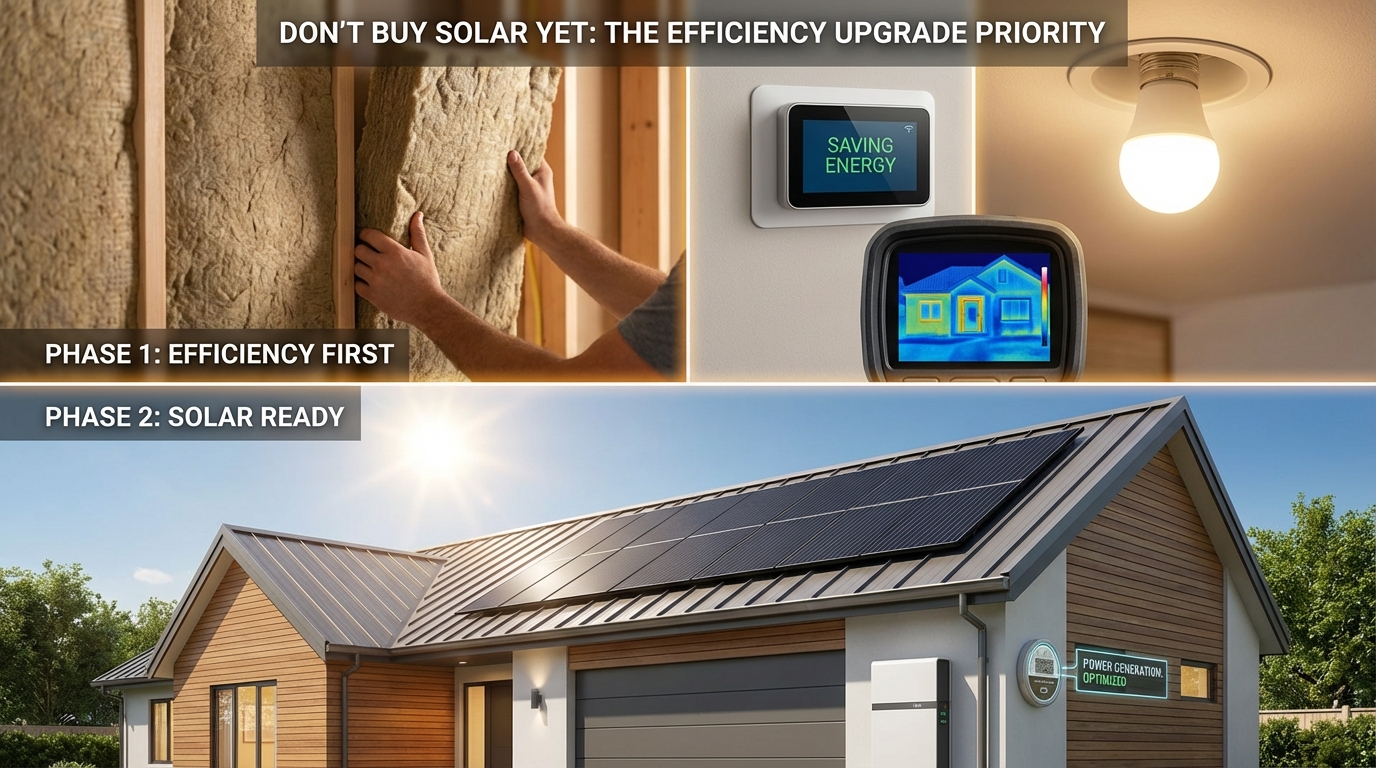
Stop: Efficiency Must Precede Solar Installation
- Prioritize Efficiency First: Adopt the Energy Hierarchy, Reduce Demand (efficiency) must aggressively precede Generate Supply (solar). Installing solar on a leaky home results in an oversized, inefficient, and costly system.
- Mandatory Envelope Work: The fastest and most guaranteed ROI comes from addressing the building envelope: commission a Blower Door test, perform deep whole house air sealing, and optimize attic insulation to achieve maximum energy savings.
- Electrify Efficiently: After sealing the structure, upgrade major mechanical systems by switching to high-efficiency Heat Pumps (for HVAC and water heating) to minimize the energy waste associated with fuel switching.
- Maximize Savings: By validating reduced consumption, your resulting solar array will be dramatically smaller and cheaper, ensuring a faster payback period and maximizing the financial impact of federal IRA rebates and tax incentives.
Table of Contents
- The Energy Hierarchy: Reduce Demand Before You Generate Supply
- The Energy Hierarchy: Reduce Demand, Then Generate Supply
- The Mandatory Whole House Efficiency Checklist
- Upgrading Mechanical Systems (Heat Pumps and HVAC)
- Cost vs. Impact Analysis: Guaranteed Returns and Faster ROI
- Validation and Optimization: Preparing for Solar Installation
- Conclusion: Maximizing Your Investment in True Sustainability
- Frequently Asked Questions: Efficiency and Electrification
You are ready to go green. You want to ditch high utility bills and embrace environmental stewardship.
The immediate, high-impact action many homeowners rush toward is scheduling a major solar installation.
In short: Stop.
While the move to Solar energy is a powerful step, it should rarely be the first step in your green home retrofit journey. This critical misconception costs homeowners thousands of dollars and often leads to oversized, inefficient systems because they failed to establish the true energy efficiency priority.
The foundational path to true sustainability (and superior immediate ROI) lies in aggressive Energy Efficiency upgrades. Recognizing this energy efficiency priority ensures that when you finally install Solar, the system is perfectly sized for your minimized demand.
Solar is the optimized secondary step, not the primary solution.
The Energy Hierarchy: Reduce Demand Before You Generate Supply
Prioritizing basic steps like switching to LED bulbs, improving insulation, and performing aggressive air sealing first means drastically reducing your average and peak load.
The Energy Hierarchy: Reduce Demand, Then Generate Supply
As industry specialists often note, optimizing the building envelope is absolutely essential to any successful whole house retrofit. This foundational approach, reducing energy waste first, establishes the critical energy efficiency priority for any project.
Understanding this hierarchy is key: you must minimize demand before you invest heavily in supply. While systems like high-capacity Battery Energy Storage Systems and rooftop Solar Panels are powerful tools for energy independence, their true efficiency and return on investment are maximized only after insulation, air sealing, and appliance upgrades have drastically reduced the home’s overall energy needs.
The Mandatory Whole House Efficiency Checklist
Before you talk to an installer about panel count, system sizing, or the cost of a new battery system or storage systems, you must address the fundamental physics of your home’s envelope. This three-step process is non-negotiable and defines true energy efficiency.

Natural Fat Burner – extra-strength B4 supports energy and metabolism for men and women.

Daily Hormone Support: Formulated for men seeking balance and stamina. Helps support natural testosterone levels, male energy, and performance. Ideal for those exploring testosterone supplement for men options.

Strength & Power: Supports increased strength and reduced fatigue during workouts. BPI Sports Micronized Creatine Monohydrate powder is engineered for high performance and consistent results in every scoop.
1. Commission a Professional Energy Auditor
You cannot fix what you cannot measure. The absolute first step is hiring a qualified energy auditor. Look specifically for BPI certified professionals.
These experts use specialized tools like the Blower Door test to quantify exactly how leaky your home is and identify the neutral pressure plane. This precise measurement is essential for determining your current energy efficiency baseline.
The audit identifies where conditioned air is escaping and where your home’s biggest flaws exist, allowing you to prioritize fixes effectively and establish the foundation for your whole house retrofit.
2. Deep Air Sealing and Weatherization: The Quickest ROI
Air leakage (often referred to as air infiltration or exfiltration) is responsible for 25% to 40% of the energy used for heating and cooling in a typical U.S. home, according to the USDOE. This is the true “low hanging fruit” of energy savings.
You must rigorously address the Stack effect, where warm air escapes through the attic and draws cold air in through the basement and rim joists. Stopping this flow is critical to reduce peak load.
Actionable Steps for Whole House Air Sealing:
- Seal all penetrations in the attic floor, basement rim joists, and crawlspaces.
- Use high-quality caulk and foam around wiring, plumbing, and chimneys.
- Install new weatherstripping around all doors and windows.
- Ensure comprehensive duct sealing is completed, especially if your HVAC system runs through unconditioned spaces.
One industry expert emphasizes the guaranteed returns of this work:
I regularly tell customers, while nowhere near as sexy, the ROI on good insulation with air sealing can’t be beat. Also you’d be amazed at what good weatherstripping can do for doors and windows. Remember, replacing old incandescent bulbs with high-efficiency LED bulbs pays for itself many times over.
3. Optimizing the Insulation Envelope (Attic First)
Once the air barrier is tight, you must optimize your insulation envelope. This step locks in the energy efficiency savings generated by air sealing.
Focus intensely on attic insulation first, as upward heat loss is the most significant factor in most homes. Aim for high R-Value targets, often R-38 to R-60, depending on your climate zone. Materials like dense-packed cellulose insulation are excellent for retrofit projects.
Do something! If you have an older home, chances are your walls and floors are also under-insulated. Addressing the whole house insulation maximizes the performance of your mechanical systems, allowing smaller, more efficient HVAC units or heat pumps to operate optimally. Remember that proper insulation and eco-friendly materials are vital for reducing demand first means your eventual solar installation will be significantly smaller and cheaper, maximizing your overall ROI.
Expert Insight
“Maximizing overall ROI in sustainable building begins by aggressively reducing energy demand, because a tighter, expert-optimized envelope means your eventual solar and storage systems can be significantly smaller and cheaper.” , Energy Efficiency Strategist
Upgrading Mechanical Systems (Heat Pumps and HVAC)
Once the whole house air sealing and insulation envelope are complete, your energy efficiency improves dramatically. This is the precise moment to address your major mechanical systems and HVAC.
By reducing your overall energy load, you simultaneously reduce your peak load. This allows you to confidently size and install smaller, less expensive HVAC units, maximizing your ROI on the entire retrofit.

Specs & Dimensions: 4.33*3.5*4.1 inches; Max flow rate: 800 GPH (3000L/H); Max lift height: up to 10 ft.; Wattage: 50W; Voltage: 110-120V

Energy-efficient performance: Energy Star Certified. Extracts heat from ambient air to deliver consistent hot water with zero emissions and a high Uniform Energy Factor (UEF) of 4.00, reducing energy costs

Energy-Saving Hybrid Water Heater – Advanced heat pump water heater technology extracts heat from the air to warm water efficiently, cutting electricity use by up to 70% compared to a standard electric water heater.
Fuel Switching: The Heat Pump Mandate
This is where fuel switching becomes mandatory for true sustainability. If you currently rely on an inefficient electric furnace or a fossil fuel system, transitioning to modern heat pumps is the key to minimizing energy waste.
Heat pumps move heat rather than generating it, making them three to five times more efficient than traditional systems, according to the USDOE.
Whether you choose a central system or a ductless heat pump (often called a mini split), this technology provides efficient, year-round conditioned air.
Look into high-efficiency models and ensure you take advantage of available IRA rebates and tax incentives to lower the upfront costs.
Similarly, address your hot water. Replace traditional electric resistance or gas water heating systems with high-efficiency heat pump water heaters.
These crucial mechanical systems work synergistically with your eventual solar installation. By electrifying efficiently and reducing your peak load, you ensure that your future solar panels (and any required battery system or storage systems) are perfectly sized for maximum performance.
Cost vs. Impact Analysis: Guaranteed Returns and Faster ROI
You want the maximum return on investment (ROI) for your green retrofit. The primary advantage of implementing deep energy efficiency upgrades (like superior insulation and whole house air sealing) is the speed and certainty of their financial returns. These energy efficiency measures are the true “low hanging fruit” of home retrofitting, establishing the essential energy efficiency priority for any smart homeowner.
Efficiency measures offer a dramatically faster payback period than a large-scale solar installation. As one expert energy auditor often highlights, efficiency yields guaranteed initial returns by immediately reducing your consumption, regardless of the weather or future utility policies.
Before you commit capital to a large battery system or expensive specialized mechanical systems like heat pumps or high-efficiency HVAC, you must understand the financial comparison.
Consider the data compiled by the USDOE:
| Upgrade Type | Typical Cost Range | Annual Utility Reduction % | Estimated Payback Period (Years) |
|---|---|---|---|
| Attic Insulation (R-49 Retrofit) | $1,500 to $4,000 | 10% to 15% | 2 to 4 |
| Whole House Air Sealing (Blower Door Test) | $1,000 to $3,000 | 5% to 10% | 1 to 3 |
| Heat Pump Water Heater | $2,500 to $4,500 (pre-rebate) | 2% to 5% | 3 to 5 |
| Full Solar Array Installation (10 kW) | $25,000 to $40,000 (pre-incentive) | 60% to 100% of electricity load | 6 to 12 |
The upfront costs for attic insulation and professional air sealing are significantly lower. The resulting guaranteed reduction in demand means the payback period is realized much faster, maximizing your initial ROI.
By prioritizing efficiency, you simultaneously reduce peak load and minimize the required size of your future solar installation and your new HVAC system. This prevents you from overpaying for oversized mechanical systems that will run inefficiently in a leaky home. Furthermore, efficiency upgrades often reduce the risk profile of your home, potentially lowering your overall premiums, a fact worth investigating when comparing rates through services like Insurify.
To maximize your initial investment, leveraging federal tax incentives and IRA rebates is crucial. While efficiency offers guaranteed returns faster than most market investments (like the volatile returns of a typical portfolio or the Fundrise Flagship Fund), homeowners often need to secure capital. Before taking on new debt for retrofitting, consider strategies for managing existing financial obligations through services like National Debt Relief or checking personalized financing options via platforms like AmONE. Once capital is secured, keeping your project funds liquid and accessible, perhaps through high-yield accounts like SoFi Checking and Savings, ensures you are ready to pay contractors promptly. Ensure you work with BPI certified professionals and understand the filing requirements overseen by the IRS to maximize your savings on efficiency measures (like duct sealing and insulation) and future solar/ storage systems.

【Attic Insulation Cover】Attic Door Insulation Cover works during the entire year, hot summers and cold winters; Creates a seal at the attic door to prevent dust or pollutants from entering your home

Thermal Resistance: R-49 value, meets attic insulation codes for heat retention.

【PREMIUM ENERGY SAVING】The Thermal Armor attic cover insulator regulates temperature year-round. It cuts energy costs and ensures comfort in every season. The aluminum foils block air exchange, maintaining a comfortable environment.
Validation and Optimization: Preparing for Solar Installation
Once you have rigorously optimized your home’s envelope through deep air sealing and superior insulation, and potentially upgraded your major mechanical systems (like installing high-efficiency heat pumps), the final step is validation.
You need to prove your energy efficiency measures are working before committing to a significant solar installation investment.
Monitoring is critical for maximizing your ROI. Advanced Energy Management Systems (EMS), like the Emporia monitor or a Sense unit, can track real-time energy use, helping you identify remaining phantom loads or spikes in consumption.
This process confirms that your efforts to reduce peak load have been successful and that your conditioned air is staying inside where it belongs.
If you are planning for future electrification, consider the infrastructure upgrade now. Installing a smart electrical panel, such as a Span.IO panel, allows for dynamic load management and seamless integration of a future battery system (like the Tesla Powerwall) and solar array.
By accurately measuring your validated, reduced consumption over several months, you provide potential installers, whether you choose a large provider like Solar City or a regional specialist like Sunburn Solar, with precise, low-demand data.
This ensures the resulting solar installation is perfectly sized for your optimized whole house, meaning you buy fewer panels, saving significant money upfront. Validating consumption data confirms that upholding the energy efficiency priority is the final, essential step in the energy hierarchy.
Expert Insight
“The strategic use of real-time monitoring tools is the final, essential step in energy optimization, ensuring that validated consumption data allows for a perfectly sized solar array, which translates directly into significant upfront cost reduction.” , Solar Energy Consultant
Conclusion: Maximizing Your Investment in True Sustainability
A truly sustainable home starts with making energy efficiency priority number one. Trying to compensate for a leaky, poorly insulated home with a massive solar array is like trying to fill a leaky bucket with a firehose.
This approach wastes money and severely undermines the long-term `ROI` of your eventual `solar installation`.
As experts consistently emphasize, efficiency is the prerequisite for effective renewable energy use.
The objective, supported by guidance from the `USDOE`, is not just to generate clean power, but to drastically `reduce peak load` and the overall energy demand in the first place.
By implementing `whole house air sealing`, upgrading your `attic insulation`, and installing modern `heat pumps`, you have optimized your home for the smallest possible energy footprint.
This disciplined approach maximizes the financial return of your efficiency work. Your minimized energy demand means your subsequent investment in a `solar installation` and necessary `battery system` is significantly smaller.
You maximize the benefit of federal `IRA rebates` and critical `tax incentives` on the smallest system size, securing the fastest possible payback period for your entire green retrofit.
True environmental stewardship begins with reduction. As emphasized by resources like City Prepping, do something! Start today with the professional `energy auditor`, seal the leaks, optimize your `insulation`, and then calculate your truly optimized solar needs.
Expert Insight
“Energy efficiency serves as the ‘first fuel’ and the foundational strategy for net-zero retrofits, minimizing demand so that expensive solar and battery systems can be scaled down, maximizing financial incentives and accelerating payback.” , Climate Finance Strategist
Frequently Asked Questions: Efficiency and Electrification
What is the biggest waste of energy in my home?
In the vast majority of U.S. homes, the primary energy waste comes from uncontrolled air leakage (what experts call air infiltration or exfiltration) and critically inadequate insulation. This leakage, often focused in the attic and around structural boundaries, results in massive loss of expensive conditioned air.
As noted by industry experts, addressing this fundamental flaw through rigorous whole house air sealing provides the fastest, most reliable ROI, far outpacing the initial returns of a standard solar installation.
Do I really need a Blower Door test?
Absolutely, yes. Guesswork is expensive. A Blower Door test, ideally performed by BPI certified professionals or a qualified energy auditor, provides an objective, quantified measurement of your home’s airtightness.
This data is crucial for targeting leaks accurately, ensuring your investment in air sealing and duct sealing is effective. You cannot truly master energy efficiency without this critical measurement.
Should I upgrade my old furnace to a high-efficiency gas model instead of a heat pump?
For long-term sustainability and to maximize your future solar installation, the answer is usually a decisive no. Transitioning to modern heat pumps (whether high-efficiency central HVAC or ductless heat pump, mini split systems) is critical for fuel switching away from fossil fuels.
Since your solar array generates clean electricity, using electricity for heating, cooling, and water heating creates a closed, renewable energy loop. This electrification path maximizes the value of your renewable mechanical systems.
Are there government incentives for efficiency upgrades?
Yes, and they are substantial. The U.S. government, guided by the USDOE and the IRS, offers significant financial support for key energy efficiency measures.
Look specifically for guidance regarding IRA rebates and federal tax incentives available for insulation, air sealing, and the installation of high-efficiency heat pump water heaters and HVAC heat pumps. These incentives make the efficiency priority checklist significantly more affordable.
If I only install LED bulbs and a smart thermostat, is that enough efficiency work?
While using LED bulbs and a smart thermostat (which helps reduce peak load) are excellent first steps (the “low hanging fruit“), they are insufficient for deep energy savings.
As noted by sustainability proponents, the most impactful changes involve structural upgrades to the whole house air sealing and optimizing the insulation envelope, particularly attic insulation. These deep retrofits provide the highest, most lasting energy efficiency gains and truly optimize your home for eventual solar and storage systems.
References
Enjoying our content? Make us a preferred source on Google.
Add us as a Preferred Source on Google